The Molo Sud is the stone breakwater that closes the harbour to the south — a kilometre of pedestrian walking that goes straight out into the sea. It's one of the places the people of San Benedetto love most and one of the city's most underrated experiences. Below, what there is to see and what you might come across if you go at the right moment.
The MAM · Museo d'Arte sul Mare
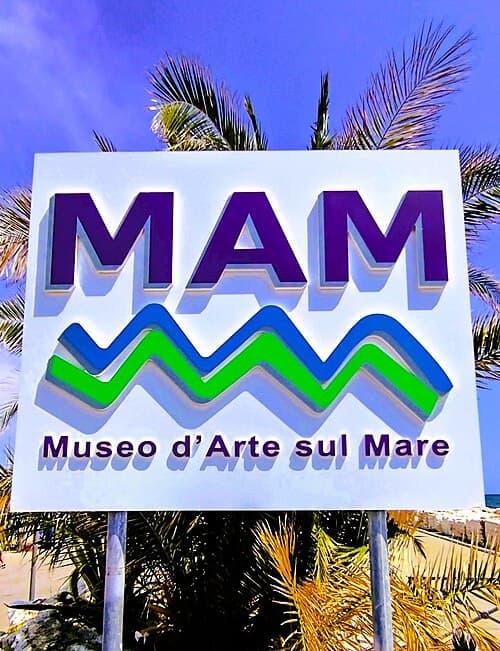
Few people know that the Molo Sud is also an open-air museum. The MAM — Museo d'Arte sul Mare, opened in 2012 — holds 145 works along the whole kilometre: 135 sculptures and 10 large murals. It grew from an idea by Piernicola Cocchiaro in 1996, and from 1996 to 2012 more than 200 artists from 40 nations carved directly onto the breakwater blocks during the annual Scultura Viva symposium. You walk and you look — it's a museum that costs nothing, never closes, out in the open.
- First section (500 m from the start of the pier): sculptures in bas-relief, high relief and in the round
- Second section (the central 150 m): the submerged Nativity — a group of sculptures sunk in the water off the pier, visible from the surface
- Third section (out to the tip): murals by international street artists
Jonathan the seagull
The most recognisable work on the pier: an eight-metre bronze sculpture created in 1986 by the master Mario Lupo, dedicated to Jonathan Livingston Seagull, the hero of Richard Bach's book. The monument is the crossing point between the first and second sections of the MAM — many people use it as a marker for their sunset photos. The book tells of a seagull who learns to fly for the pure joy of flying, not to find food: in a harbour full of fishermen and real gulls, the choice of subject is less obvious than it seems.
The fishing boats coming home · the escort of gulls
If you go to the Molo Sud in the late afternoon, you may see the paranze (San Benedetto's fishing boats) coming back into harbour after a day's fishing. It's quite a sight: the boats come in, in line, towards the harbour mouth, and behind each one is an escort of gulls beating their wings — they know there'll always be a fish or two on shore. The sound is distinctive — working sirens, the voices of the fishermen, the cries of the gulls multiplying.
The dolphins · if you're lucky
It happens — not often, but it happens — that dolphins come right into the harbour, drawn by the fish. It isn't something scheduled, you can't book it. But sometimes, especially in autumn or at the start of summer, someone looks down from the pier and sees them go by. Worth keeping your eyes on the water as you walk.
The blue lighthouse · at the far end
At the tip of the pier stands the blue lighthouse, atop a little stone turret. The light turns at night; by day it's just a fixed point you can see from the whole northern seafront. The view from the tip is the one you remember: the harbour on one side, the open sea on the other, the city at your back. The sunset here — if there's no wind — is worth the trip.
The full walk
From the house, the Molo Sud is about 900 metres away — ten minutes on foot. You walk towards the harbour (passing the fish-market area), enter the pier at the harbour mouth, walk a kilometre out to the lighthouse, then turn back. There and back: around 2.5 km in total, an hour to an hour and a half at a gentle pace. For anyone who doesn't want to walk the whole way, even just the first 300 metres are worth it — that's where the MAM begins and where most people end up stopping anyway.
FROM THE GUIDE
Molo Sud · listing with coordinates
Location, directions, other practical information.
OpenEvery day is different · what to look for when you come back
From here you can see sunrises and sunsets from the same stone — and no two mornings are ever alike. The light of the Adriatic is a light that keeps changing its mind: pastel today, blazing tomorrow, milky with mist a week from now. A patient observer finds something new here every day: the shape of a cloud that looks like an animal, the silhouette of a fishing boat coming back into harbour, the city lights coming on one by one in the evening. There's no typical visit because there's no typical pier: the Molo Sud is a space that asks for your presence, not a checklist.
The sound of the sea · a story of its own
The other dimension of the Molo Sud — the one that photos can't quite hold — is the sound. The wave against the breakwater rock has a whole scale of shades to it: from the slow hiss of calm days, to the sharp, powerful crash of days with a libeccio blowing, to the long breath of the backwash when the wind has only just dropped. Sailors use it to find their bearings without looking; for guests it serves, quite simply, to remind them what the sea is. In the videos below you'll find some of these moments with the sound included — tap a frame with the "🔊 audio" badge and the sound begins. It's our way of bringing a piece of the sea to anyone at home who, for whatever reason, needs it right now.
FROM THE GUIDE
A page of nothing but sea · for those who've already been here
The full archive, full screen, with no distractions. Made for anyone who has left San Benedetto and now, at home, misses it · waves, skies, evening light.
OpenMOMENTS OF THE PIER · FROM OUR ARCHIVE
What you see and what you hear
The Riviera delle Palme · what to know along the way
To reach the Molo Sud you cross the Riviera delle Palme — not just a tourist name, but a real project. The San Benedetto seafront was designed by the engineer Luigi Onorati in 1931 and opened the following year. The same Onorati who also designed the Palazzina Azzurra nearby. The palms arrived in several stages; today there are around 8,000 of them along the six kilometres of seafront within San Benedetto alone, of three different species (Phoenix canariensis, Washingtonia, Phoenix sylvestris). The restoration of 2005–2007 added 10 themed gardens along the way. The name "Riviera delle Palme" as a tourist brand (which also takes in Grottammare and Cupra, for a total of 15 km) has been official since 2000, when the consortium was set up.
FROM THE GUIDE
Riviera delle Palme · listing
Six kilometres of seafront, 8,000 palms, 10 themed gardens. The listing with all the details.
Open