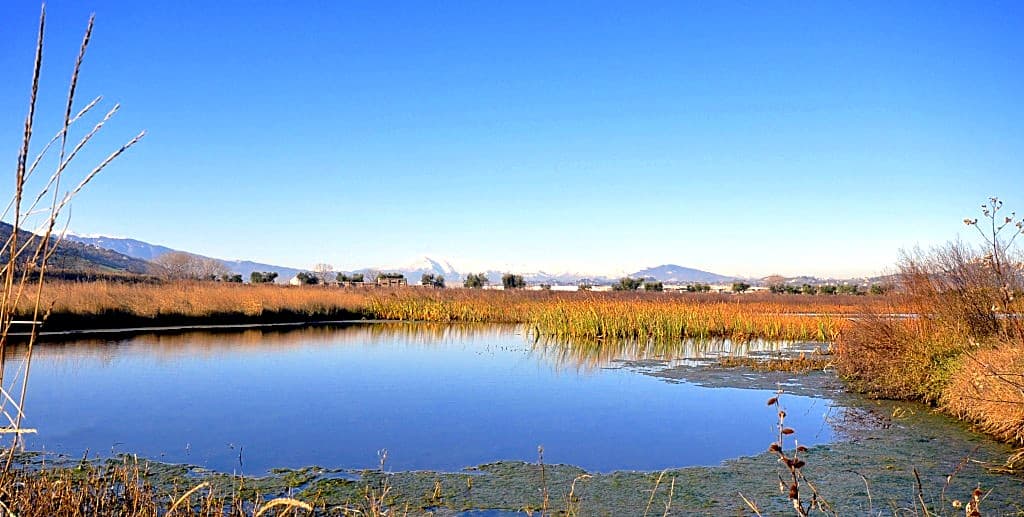
A few kilometres south of the house, where the river Tronto meets the Adriatic, there is a ribbon of sand, reedbed and lagoon that is at once the smallest and the most singular of the regional nature reserves of Le Marche. It is called the Sentina Regional Nature Reserve, it lies within the municipality of San Benedetto del Tronto, and it covers 180 hectares between the district of Porto d'Ascoli and the mouth of the Tronto. For birdwatchers it is a name that carries weight: it is the only coastal wetland left between the Po Delta and the Gargano — an essential corridor for the migration of birdlife along the whole of the central Adriatic coast.
Below is a guide for anyone staying at La Tana who wants to fit the Sentina into a day or two of their stay: what to see and when, how to get there by bike or on foot from the house, what to bring, the main trails, the guided visits run by the C.E.A. Torre sul Porto, and the visitor's code of conduct. The reserve is free to enter and open all year round.
EXTERNAL SOURCE
Photo source · Official Sentina Reserve gallery
The photographs of the Sentina in this article come from the reserve's official gallery — by Giuseppe Pignotti, Andrea Casalboni, Antonio Neroni, Silvio Marini and Alessandro Casoni. Click to browse the full gallery with all the photographers.
Open the documentWhat the Sentina Reserve is
Established by regional resolution no. 156 of 14 December 2004, the Sentina is the smallest protected area in Le Marche by extent, but one of the richest in biodiversity. It runs for about 1.7 km along the coast, between the built-up area of Porto d'Ascoli to the north and the mouth of the Tronto to the south — the natural border with Abruzzo. The habitats are unusually varied for such a contained space: dune ridges with the pioneer flora typical of the Adriatic (much of it now vanished elsewhere), wetlands behind the dunes, salt meadows, a reedbed, the river mouth, a few fringes of pinewood and some cultivated farmland. The European Union has recognised the area as a Site of Community Importance; the Comune of San Benedetto del Tronto manages it with the support of the Province of Ascoli Piceno and the Marche Region.
The species — a calendar by season
The Sentina's entry on the international portal Birdingplaces.eu, maintained by the community of European birdwatchers, lists around 180 species observed in the area among migrants, winterers and breeders — the figure most often cited. The nature reserve carries out bird monitoring through the C.E.A. Torre sul Porto but does not publish a complete checklist on its official site; the sightings updated from season to season are found on Birdingplaces.eu and on eBird (filter for 'Riserva Sentina'). Not all 180 species are seen every day, and not all in every season — that is precisely the point of birdwatching at the Sentina: knowing what to look for and when. Below is a seasonal summary drawing on parks.it, Birdingplaces.eu and the observation data of local enthusiasts.
EXTERNAL SOURCE
Source · Birdingplaces.eu · Sentina Reserve entry with top species
The international page dedicated to the Sentina · it states 'around 180 species' and lists the species most visible to visitors: golden oriole, European bee-eater, Sardinian warbler, black-headed bunting, zitting cisticola. A starting point for anyone wanting to consult the list.
Open the documentEXTERNAL SOURCE
Source · eBird · Le Marche
An international database run by the Cornell Lab of Ornithology · recent sightings are uploaded by birdwatchers themselves · filterable by area (Riserva Sentina), by season and by species.
Open the documentSpring · March–May · the great passage
This is the peak season. The migrants come back up from Africa along the Adriatic, and the Sentina becomes an obligatory stop. The first two hours after dawn are the best moment — around 6.30–8.30 in March, 5.30–7.30 in May. The wetlands behind the dunes (reached by the central trail, about fifteen minutes from the entrance gate) fill with little egrets hunting, passage waders (redshank, greenshank and whimbrel reported on recent outings) and late ducks. The black-winged stilt — the reserve's symbol, recognisable by its black-and-white plumage and very long coral-red legs — returns to settle in the salt areas to breed: it is best seen from the observation hide between 7.00 and 9.00. In recent years passage flamingos have also been observed, in small groups: a presence not yet established but documented on Birdingplaces.eu in the April observations. Among the most audible and visible passerines of the period: the golden oriole (brilliant yellow, with a fluting song — easily heard among the tamarisks along the main trail), the European bee-eater (exotic colours, wheeling flights over the open meadows), and then subalpine warblers and cisticolas in the coastal scrub.
Summer · June–August · nesting
Summer is the breeding season. The species to look for is the Kentish plover (Charadrius alexandrinus), a small wader protected at national level that lays its eggs directly on the sand of the dunes — one of the reasons the trails must be respected with absolute care. In San Benedetto, since 2024, the Mayor has issued a specific ordinance each season to protect its nests: worth knowing before setting foot on the shoreline. The black-winged stilt nests in the salt grasslands, building its nest on the ground from twigs and mud (incubation of 25–26 days, 3–4 eggs per clutch). You can still see herons, kingfishers near the reedbed, and in the reedbed itself the species typical of the Adriatic reedbeds.
Autumn · September–November · the return migration
The flow reverses: the birds head down towards their African or Mediterranean wintering grounds. The lagoon behind the dunes hosts groups of waders on stopover — lapwings in particular, among the emblematic species reported by the reserve. Among the raptors on passage, the marsh harrier is recorded. It is also the season of rarities: along the Adriatic, unexpected species turn up seeking shelter after long crossings, and the Sentina, being the only wetland available, often takes in unforeseen visitors. It is worth keeping the camera ready and checking the recent sightings on the ornithological portals before setting out.
Winter · December–February · the winterers
Winter at the Sentina is surprisingly alive. Coots populate the lagoon in significant numbers — groups of thirty to fifty birds are normal in January, making them one of the most visible species of the cold months — accompanied by wintering ducks (mallard, garganey, occasionally shoveler). Among the raptors, the marsh harrier is reliably present, hunting over the reedbeds, especially visible in mid-morning when the thermals allow patrolling flights. The low January light over the lagoon in the early hours of the morning — between 8.00 and 9.30 — is the most scenic moment of the year for photographers: the mist over the waters behind the dunes lifts slowly, and the silhouettes of the birds emerge from the backlight. The crane is among the species reported passing over the area on Birdingplaces, though not regularly; it is worth checking the most recent sightings on the eBird 'Riserva Sentina' hotspot before setting out.
Getting there · by bike from the house
The main entrance to the reserve is at the end of Via del Cacciatore, in the district of Porto d'Ascoli, about 5–6 km south of the house. From La Tana the loveliest route is the cycle-and-pedestrian path along the seafront: you come out onto Via Risorgimento, join the cycle path at the palm-lined seafront, and ride south for about four kilometres to Porto d'Ascoli. From there a short stretch on the road (Via Mare, then left into Via del Cacciatore) brings you to the reserve's wooden gate. Average time: 20–25 minutes by bike at an easy pace.
- By bike from the house: about 5–6 km · 20–25 minutes · entirely flat, most of it on the cycle-and-pedestrian path
- By car: about 10 minutes, parking at the end of Via del Cacciatore (free, limited spaces)
- On foot: only for keen walkers · about an hour each way
- By train + a short walk: Porto d'Ascoli station is about 1.5 km from the entrance
- By bus: the Start spa urban lines stop at Porto d'Ascoli (seafront), then 1.5 km on foot
EXTERNAL SOURCE
Open directions in Google Maps · from the house to the Sentina
The route by bike, car or on foot. The map shows the itinerary along the seafront to the entrance on Via del Cacciatore.
Open the documentEXTERNAL SOURCE
Source of the 'by bike' photo · Wikimedia Commons (CC BY-SA)
The image of the bike in the reserve comes from Wikimedia Commons under a CC BY-SA licence.
Open the documentWhat to bring
- Binoculars (8x40 or 10x42 is ideal for waders at medium range); a small spotting scope is useful but not essential
- A field guide to Italian birds (the classic Svensson/Mullarney) or an app on your phone (Merlin Bird ID, eBird)
- Low waterproof shoes in spring and autumn; light walking boots in winter; closed sandals in summer
- Clothing in neutral tones (green, beige, grey) so as not to frighten the birds
- Mosquito repellent from late spring to September (the wetland produces plenty of them)
- Water and something to eat: there are no refreshment points inside the reserve
- A hat and sun cream in summer — the sun on the dunes is strong
The main trails
The trail network is well mapped and can be visited without a guide. The parks.it portal describes three reference itineraries, supplemented by the maps the reserve makes available in PDF:
- The Sentina by bike · about 1 hour · easy · runs through the flora, fauna and main viewpoints, ideal for a first reconnaissance
- The Sentina for all · about 2 hours · a route accessible to wheelchairs and pushchairs too, covering the key points
- The beach, the wetlands and the Torre sul Porto · about 3 hours on foot · the most complete itinerary, going down to the shoreline, skirting the wetlands and reaching the sixteenth-century tower
- Secondary themed trails · del Cavatone, di Strëchì, della Foce, della Pantiera, di Ndòndò (390 m, between two rows of olive trees, up to an ancient black poplar — the tallest tree in the reserve)
For serious birdwatching, the walking itineraries that include the observation hide overlooking the wetlands behind the dunes are the ones that matter most — the reserve's official map marks its exact position. For a worthwhile visit, allow at least 2–3 hours; anyone photographing or waiting for a target species should reckon on half a day.
The best hours
The rule of birdwatching everywhere applies: dawn and dusk are the golden hours, both for the birds' activity and for the light. In spring and autumn the ideal is to be at the entrance as the sun rises — many species are active in the first two hours of daylight and turn discreet by mid-morning. In summer, at 7 in the morning things are already much better than at 11 (for you and for the birds). In winter the pattern flips: mid-morning is better (8.30–10.30), when the sun warms the air, the insects take to the wing again and the passerines come out of the bushes. Low tide exposes the mud of the lagoon and draws in waders: check the tide tables for Pescara or Ancona (the nearest reference) the evening before, and try to time your outing for the window 1–2 hours before low water, when the mud is just being uncovered.
A suggested itinerary · a first 4-hour visit
For anyone who doesn't know the Sentina and wants to make the most of a first morning, here is a tried-and-tested route that takes in the richest habitats without going beyond 4 hours in total, starting from the main entrance at the end of Via del Cacciatore.
- T+0:00 · Entrance gate · A few minutes to read the information panels (map, rules, seasonal target species). Public toilets here (may be your last chance).
- T+0:15 · Central trail to the first fork · A walk among tamarisks and low reedbed · the first good area for the zitting cisticola (Cisticola juncidis), a tiny passerine that performs its song-flight up and down over the grass.
- T+0:45 · Observation hide · wetland behind the dunes · The most productive spot in the reserve. Stay at least 30–40 minutes in silence, eyes on the lagoon. Black-winged stilt, little egret, coot (in winter), passage waders. Low tide multiplies the numbers present.
- T+1:30 · Della Foce trail heading south · Leave the hide and follow the trail skirting the reedbed towards the mouth of the Tronto. Marsh harrier (low, hunting flight), kingfisher near the pools, ducks in the southern lagoon.
- T+2:30 · Beach · Kentish plover nesting area in summer · From April to July, stay on the marked trail, do not go down onto the dune sand. The area is also good for migrating gulls (slender-billed gull, sandwich tern during the passages).
- T+3:15 · Torre sul Porto · return · A historic sixteenth-century building (a watchtower against pirate raids). From here the shortest trail leads back to the gate.
- T+4:00 · Back to the gate and bike home · 25 minutes' ride along the seafront and you're in the garden at La Tana for a shower and a mid-morning coffee.
The apps to download before you go
- Merlin Bird ID (Cornell Lab, free on iOS/Android) · download the 'Europe: Italy' pack in advance (≈400 MB) for offline identification. The 'Sound ID' feature recognises birdsong recorded on your phone — invaluable for the passerines hidden in the reedbed. Interface available in Italian.
- eBird (same organisation, free) · lets you see recent sightings uploaded by other birdwatchers in the area. Search for the hotspot 'Riserva Naturale Regionale Sentina' and filter by 'Recent Visits' in the last 2 weeks. Also useful for logging your own checklist (it contributes to global monitoring).
- Birdingplaces.eu (web version, not an app) · an entry with the top visible species and a map of the observation points · worth consulting the day before.
- Tide Charts Italy or Marea.net · for planning your outing around low tide (ref. Pescara or Ancona).
- Maps.me (free, offline) or Google Maps in offline mode · download the Porto d'Ascoli + Sentina area before you leave, as the phone signal in the reserve is patchy, especially near the river mouth.
For photographers · brief technical notes
- Telephoto lens · 300mm useful, 400mm recommended, 600mm ideal for waders at a distance. Without a telephoto it is still perfectly possible to photograph the landscape and the larger species (herons, black-winged stilt up close from the hide).
- Light · the reserve faces east towards the sea and south towards the river mouth. At dawn: warm, raking light across the reedbed, ideal for portraits of passerines perched high on a stem. In the afternoon: better the inland side towards the lagoon behind the dunes, with the sun behind the photographer. Never use flash — banned by the rules and a disturbance to wildlife.
- Tripod or monopod · useful for long waits at the hide · take care not to take up the whole observation opening: the hide is small, and sharing the space with other visitors is the norm.
- A neutral fabric cover · some local photographers carry one to cover a white lens while waiting in the hide · birds react worse to bright white than to green or grey.
Guided visits · C.E.A. Torre sul Porto
For anyone who doesn't feel confident identifying the species alone, or who wants a thorough first introduction, the reserve organises guided visits through the C.E.A. (Environmental Education Centre) Torre sul Porto. The outings include birdwatching with binoculars provided, a visit to the historic buildings in the reserve, a botanical trail and the chance to see rare plant species now vanished from the rest of the Adriatic. The indicative cost is €5 per person for groups on request; school visits are free for institutes in San Benedetto and €1 per child for other municipalities. Contacts for the environmental guides: Sabina (339 4985777), Alessio (349 7234140); general enquiries on the reserve's number, 0735 794278.
EXTERNAL SOURCE
Source · Sentina Reserve · activities and guided visits
The official site of the Sentina Regional Nature Reserve · prices, C.E.A. Torre sul Porto contacts, the calendar of outings.
Open the documentThe birdwatcher's code of conduct in the reserve
A protected area works for as long as every visitor treats it as one. The rules, set out on the panels at the entrance and summarised in the regulations, are few and sensible:
- Stay on the marked trails · the dunes are fragile and home to nests at ground level (the Kentish plover above all)
- No playback recordings · drawing birds in artificially with playback alters their behaviour and can ruin nesting
- No collecting of plants, shells or materials · the dune flora is almost all protected
- Dogs · banned in the strictly protected areas (even on the lead and muzzled); allowed on the lead only on the shoreline and on the trails marked as accessible
- Litter · take everything away with you, biodegradable bags included
- Quiet voices, slow movements · you see more and disturb less
FROM THE GUIDE
A holiday with your dog in San Benedetto
The 2026 guide with the official dog beach, Parco Bau, trusted vets and the up-to-date legal rules for walks in town.
OpenHow to combine the Sentina with the rest of the day
A morning at the Sentina leaves the afternoon free for the rest of the area. Two combinations that work well:
- The Sentina in the morning + a Piceno village in the afternoon · Acquaviva Picena (the fortress), Offida (lace and wines), or Ripatransone (the belvedere and the narrowest alley in Italy) — all less than half an hour from the house
- The Sentina at dawn + an olive mill or winery in autumn · the hills behind San Benedetto are the land of Rosso Piceno and extra-virgin olive oil; October and November are the right time for visits with tastings
- The Sentina + back to the house at midday · the experience of rinsing your boots in the garden at La Tana, drying your binoculars under the pergola and making a coffee in the shade of the palms before heading off again — it is one of the simplest ways to justify choosing a house with a garden over a hotel room
FROM THE GUIDE
Eight villages within 40 minutes
Grottammare Alta, Acquaviva Picena, Offida, Ripatransone, Civitella del Tronto in Abruzzo: each one for a different reason.
OpenWhy La Tana makes a sensible base for birdwatchers
The trip to the Sentina is done by bike from the front door, without taking the car. The 110 m² garden is a natural decompression point after a three-hour outing in the sun: there is shade from the palms, a big table to clean your kit on, room to lay out boots and clothing. The house is a whole apartment, not a hotel room — which means you can come back mid-morning for a snack, leave your binoculars in the living room between one outing and the next, keep your camera batteries on charge in your own kitchen. For a stay of three or four days devoted to the reserve and the nature spots around it (the mouth of the Tronto to the south, the Piceno hills to the west, the Sibillini National Park less than an hour and a half away), La Tana works better than a hotel.
FROM THE GUIDE
The garden · 110 m² of private space
The decompression space after your outings in the reserve. Enclosed, with shade and a big table.
OpenFROM THE GUIDE
Three days in San Benedetto · the menu of options
How to fit the Sentina in with the rest of the town — the sea, the villages, the Paese Alto, the Molo Sud.
OpenOfficial sources and further reading
EXTERNAL SOURCE
Source · Official site of the Sentina Nature Reserve
The official page run by the Comune of San Benedetto del Tronto · activities, downloadable maps, contacts.
Open the documentEXTERNAL SOURCE
Source · Parks.it · Sentina Reserve entry
The national entry for the protected area, with itineraries, official data and a list of the habitats.
Open the documentEXTERNAL SOURCE
Source · Birdingplaces.eu · the birdwatchers' entry
The international page dedicated to birdwatchers: top species, a map, practical tips, access.
Open the documentEXTERNAL SOURCE
Source · Parks.it · the Sentina's itineraries
A description of the reserve's three official itineraries: times, accessibility, difficulty.
Open the documentWhat to take away
The Sentina is not a spectacular park in the photographic sense of the word: no waterfalls, no Alpine landscapes. It is a handkerchief of sand and water that, in a country which has concreted over almost all of its coast, has managed to stay what it was. For anyone who arrives with a pair of binoculars and the right patience, it gives back a rare kind of silence — the kind in which you hear only the wind on the reedbed, the distant call of a black-winged stilt, the beat of wings as a little egret lifts off the lagoon. It is worth the twenty-minute ride from the house, and worth coming back to more than once in the same stay to catch different hours of light and different tides.