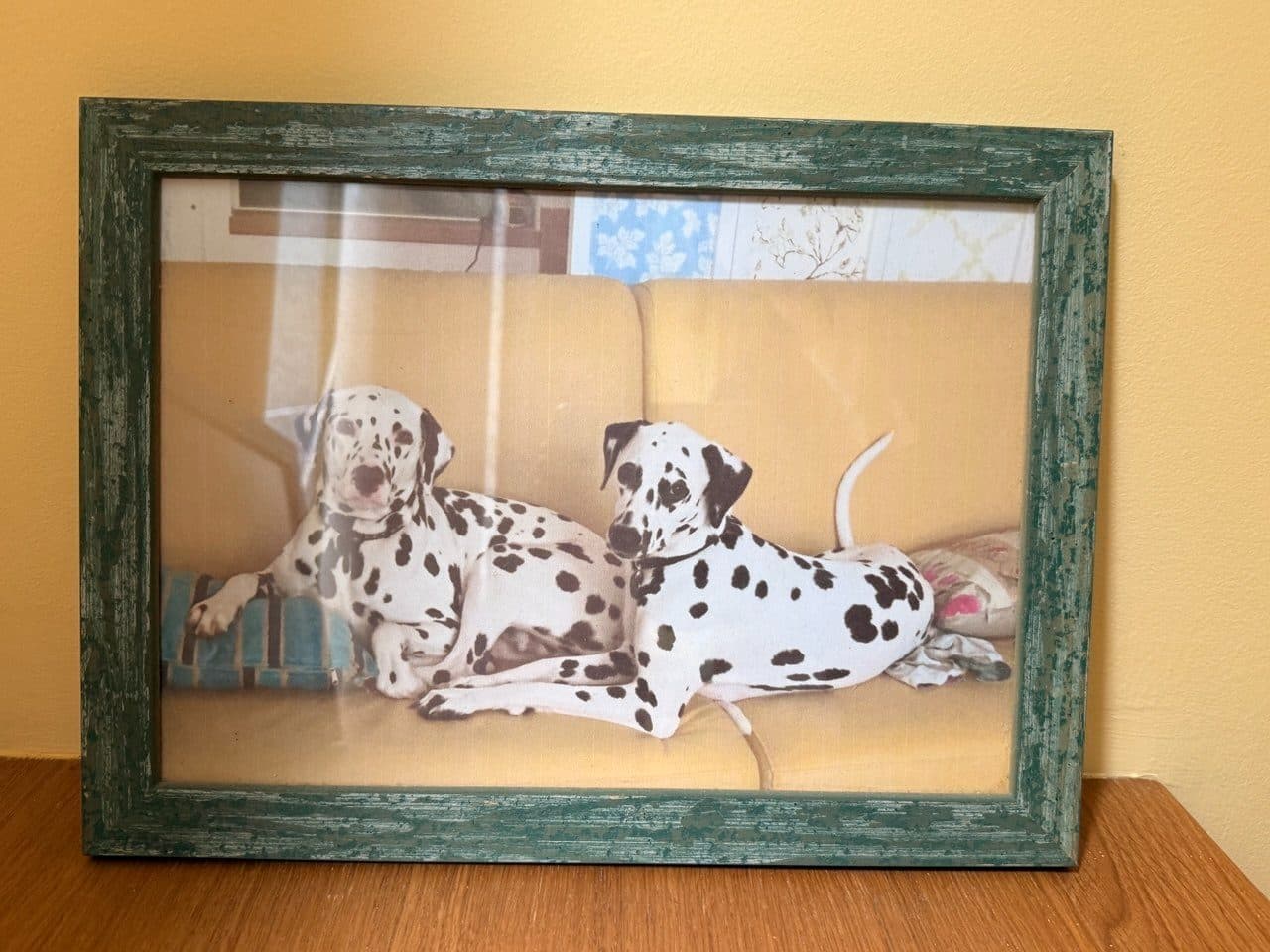
Four dalmatians have passed through this apartment. The very first was called Jacky — the dalmatian with whom it all began. Then came Lucky (a male too), Vanilla and Jackie (sisters, both females): three dogs who lived here together, in the garden and in the rooms. Today Lucky is no longer with us. Vanilla lives with us (the family lives on the floor above the guest apartment), Jackie lives at our daughter's house on the next street — it's all in the family. It's from the three of them that the house took its name.
The dalmatian · a breed with a history of its own
Dalmatians are one of the most recognisable breeds in the world — their white coat with black or brown spots has made them icons of films and cartoons — but behind the image lies a history few people know. The first written reference dates back to 1375, when Peter, Bishop of Đakovo, described "a hunting dog, found chiefly in Dalmatia, with a short white coat and round black spots" — and called it Canis Dalmaticus. Between the 18th and 19th centuries, in England and across Europe, they became "carriage dogs": they ran alongside horse-drawn carriages to protect them from highwaymen and to show off the owner's status. They were dogs of prestige, a symbol of nobility.
In 19th-century America they found another calling: firehouse dogs. When fire engines were still horse-drawn, dalmatians ran ahead of the wagon to clear the way through crowded streets and to calm the horses at the scene of the fire. It's from that role that, even today in the USA, the dalmatian is the symbolic mascot of the fire service. It's no accident that they are the breed of "the 101": Disney chose the dalmatian precisely because it was already lodged in the popular imagination as a family dog, well before the 1961 cartoon.
The dalmatian is also unique for its uric acid metabolism — a genetic inheritance that makes it prone to kidney stones and calls for a diet low in purines. It's a sporting dog: bred to run alongside carriages, it has exceptional stamina and needs daily exercise. It isn't a breed for anyone after a quiet dog for the sofa. But to those who can offer it space, activity and, above all, constant company (it copes badly with being alone), it gives back a bond that is exclusive, intelligent and deep.
The breed that isn't the one from the cartoons
People imagine dalmatians as cheerful, playful, perfect for any family — that's the image from the films. The truth is different. They're demanding dogs, with a strong character, not easily trained. They bond deeply with the people they live with: you can't leave them alone in the garden, they don't live outdoors, and they suffer badly when abandoned. They also have their health fragilities (deafness, kidney stones, and autoimmune thyroiditis affects 10% of the breed). It's a breed that demands constant attention — and to those who know how to take it in, it gives back a rare bond.
The garden, each one its own spot
Each of our dalmatians had its own way of inhabiting the garden. Lying in the sun was the shared ritual — on the grass or on the warm tiles, for hours on end. One loved to dig always in the same spot; another preferred to sniff along the hedges, following the courtyard birds.
When the rabbits arrived in the garden, each one reacted in its own way. Lucky couldn't help himself: the moment he sensed one, he had to chase it. Vanilla, on the other hand — the one who lives with us now — doesn't even notice them: sometimes one of the rabbits comes up onto the upper terrace where we live, and she stays perfectly calm, as if she saw nothing at all.
Blackbirds nest in the garden, and every year a few chicks fall out of the nest. Until they learn to fly, they stay in the grass, halfway between hedge and lawn. For our dalmatians it was the most interesting event of the year — the chicks had to be watched over with double the care, until they took to the wing.
Lucky
The oldest of the three is the one who is no longer with us. Dogs — like all the animals who have been part of the family — stay in our thoughts the way people do. Lucky was the one who understood before there was any need to explain, who always knew how we were feeling before we did. He stays inside the house, even if no longer in person.
Vanilla and Jackie · the sisters who don't get on
Vanilla and Jackie are sisters — both pedigree, with their papers in order. One is white with brown spots, the other white with black. If you imagine them inseparable like in the cartoons, the reality is otherwise: they don't get on, and each lays claim to her own space. When they cross paths, each shows the other where her kingdom ends. They both live in the family — Vanilla with us (the family lives above the guest apartment), Jackie at our daughter's house on the next street.
And the other ninety-eight?
When we used to go out walking with three dalmatians together, people would regularly stop us to ask: "And where are the other 98?" The automatic film joke — the 101 dalmatians. It happened so often that it found its way into the name of the house: "La Tana dei Dalmatini" carries that within it too.
The portraits on the walls · and a possibility
In our paintings, in green and red wooden frames, are Vanilla and Jackie — the two dalmatians still with us. The portraits will welcome you as you come in, and they're part of the tour of the house when we show you round at check-in.
What carries on from their time
A hundred and ten square metres of lawn, palms, a terracotta amphora, sun loungers in the sun. Three rabbits living free in the grass, the budgerigars in the courtyard, the silent aquascape in the bedroom, the blackbirds nesting every year. The house has never been silent — it isn't today, and it wasn't when our dalmatians ran about it.
FROM THE GUIDE
The three rabbits of the garden
They live free on the lawn. What to do, what not to do. The memory of the dalmatians who chased them — and of Vanilla, who ignores them.
OpenThe heart of stones
In the furthest corner of the garden — the one on the left, where the table and chairs are, the relaxing corner — a wooden heart full of white stones hangs on the wall. A little collection grown over the years, a stone for each thing worth remembering. This too is part of the house that carries on.