In October the gulls become the masters of the seafront. The beach clubs have put away their umbrellas, the palms cast a longer shadow, the Adriatic light turns oblique and broad. It's the season few people know of an Italian seaside town: when the restaurants come back to life for the locals, when the noise of the traffic drops a couple of notches, when time — that slow time writing asks for, and that everywhere seems lost — reappears in the hours of the day.
Real silence, in Italy, is harder to find than people say. The inland villages have tractors, bells, dogs; the big cities have their own permanent voice; the tourist resorts, even in winter, keep an undercurrent of passing trade. Coastal towns out of season remain one of the few concrete answers, and it's an answer that many writers — Italian and foreign — rediscover year after year. La Tana dei Dalmatini is one of the houses where this is possible.
Why San Benedetto, why winter
The Marche Adriatic enjoys a Mediterranean microclimate: the seasonal winter average is around 7°C, in January the highs settle around 11°C and the lows around 6°C. Snow happens, frosty nights happen, but on most days winter is a grey-mild kind — the kind that allows a walk to the pier after lunch without too many layers. It isn't a Californian-desert climate, but it's mild enough that you aren't forced to stay shut indoors for weeks on end.
The town in low season is a real town. The pedestrian centre stays walkable, the newsagent opens at 7, the historic cafés (Caffè Florian on Viale Secondo Moretti, Antico Caffè Soriano on Viale Buozzi) stay open with a local crowd, and a dozen or so restaurants keep open even from December to February. The Giuseppe Lesca Public Library — at Viale Alcide De Gasperi 124, about 700 metres from the house — is open Monday to Friday 8:30–19:30, Saturday 8:30–13:00, free entry. It's one of the best public places in town for anyone after a second working space outside the house, especially on the rainier afternoons.
Connections: San Benedetto station is on the Adriatic main line, 650 metres from the house. From Bologna it's about 3h by Frecciarossa, Frecciabianca or Intercity (usually direct); from Rome 3h–3h30; from Milan the direct Frecciarossa trains on the Adriatic line (which continue to Bari/Lecce, stopping at SBT) take about 4h–4h30. For anyone coming from abroad, Ancona airport (75 km) and Pescara airport (75 km) are the nearest. Up-to-date timetables: trenitalia.com / italotreno.it.
The day, as it might take shape
There's no right day — there's the one that works for you. The one that follows is the structure many writers (Italian and foreign) have told us they found here, all on their own:
- Morning · coffee at home, two or three hours of writing at the big living-room table. The light comes in through the floor-to-ceiling window onto the garden — filtered, not harsh, changing slowly through the morning. The windows look onto an enclosed inner courtyard, not the street: the outside noise arrives muffled.
- Late morning · a half-hour out. Ten minutes on foot is the seafront; four minutes the pedestrian centre for a coffee and the newsagent; eight minutes the Molo Sud, a kilometre of stone reaching out into the open sea.
- Lunch · something light at home (the kitchenette is well equipped, with an induction hob, microwave and a capsule coffee machine) or in an osteria in the centre that stays open in low season.
- Afternoon · a second block of writing or revision. For anyone who prefers a change of air, the Lesca Library is eight minutes on foot: desks, structural silence, public internet.
- Evening · dinner out (fifteen restaurants within a hundred metres of the door) or at home, before a walk to the port. The blue lighthouse at the tip of the Molo Sud is one of the most striking spots on the coast in winter — empty, windy, exactly what you need after finishing a difficult chapter.
What's in the house that matters to a writer
- A proper white writing desk in the second bedroom, beside the window. It can stay there or be moved to the double room, depending on where you prefer to work early in the morning.
- A big table in the living room, handy for anyone who needs to spread out notes, manuscripts, sources — not just a laptop. It's the table where most guests end up working over the course of the day.
- Fibre Wi-Fi throughout the house, with a router and a booster: full coverage even in the bedrooms and the garden. For anyone who likes a backup, there's also an excellent 4G/5G signal in the area.
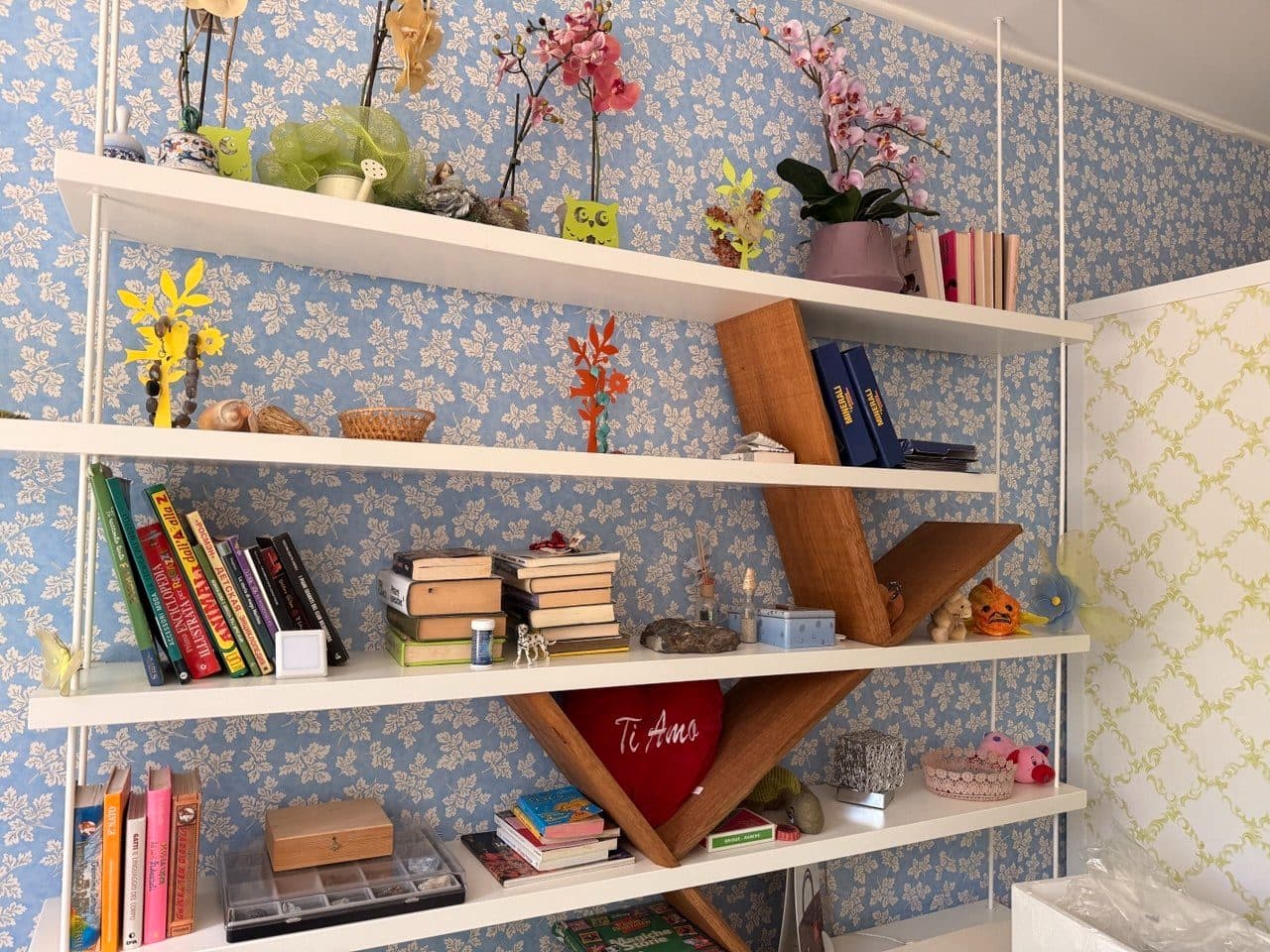
- A family library with hundreds of volumes, mostly in Italian: contemporary fiction, classics, non-fiction, a few art monographs. It isn't a service — it's company. Those who can read other people's books often find a way into their own.
- Reasonable acoustic quiet: thick walls, an inner position away from the street (the floor-to-ceiling windows face the garden's enclosed courtyard). It isn't a sound-proof studio, but it's significantly quieter than the average flat in the town centre.
- A kitchenette equipped for anyone who doesn't want to depend on restaurants: induction hob, oven, microwave, fridge, capsule coffee machine, kettle. In a week of work, knowing you can eat at home when a chapter won't close changes the whole day.
FROM THE GUIDE
The garden · dedicated page
A hundred and ten square metres of enclosed lawn with palms, sun loungers, hydrangeas. In winter it's quieter than ever.
OpenLengths, cost, booking
In low season (roughly October–April, festive periods aside) we accept long stays by personal arrangement — whole weeks or whole months. Rates drop significantly compared with summer, and for stays of two weeks or more a dedicated price can be discussed. The order of magnitude is well below that of structured writers' retreats (which often start at €1,500 a week), and this is the whole house, not a shared room.
The best way to book a long writing stay is to write to us directly — not to go through Booking or Airbnb. Include rough dates, a short introduction to who you are (the book you're working on, the kind of day you imagine, any animals coming with you), and any specific needs. We reply personally. It isn't an automated channel: it's the way we've always worked with the guests who stay for a long time.
What La Tana is NOT
In all honesty — and because it also helps those who book — it's worth saying what not to expect. La Tana isn't a structured residency for artists, with other writers, group moments, a mentor in the house. You're on your own, you do it on your own, you organise the day on your own. There's no facilitator, there's no programme. There's no food included — there's a kitchenette and the centre a hundred metres away. It isn't a dedicated sound-proof studio: it's a family house, well kept, quiet by town standards, but a house. And there isn't — at least not automatically — a community of other writers to compare notes with: for that there are the structured Italian retreats (Lo Spazio Letterario in Bologna, Dimore Letterarie with bases in Romagna, Tuscany and Puglia, the Bogliasco Foundation in Liguria for international authors), and they're a different experience altogether.
EXTERNAL SOURCE
Source · Lo Spazio Letterario · 2026 residencies
Structured writing residencies in Bologna · a good alternative for anyone after feedback and mentorship.
Open the documentWho this works for
- Anyone finishing a long draft — a novel in its last fifty pages, a non-fiction book in its concluding chapter, a screenplay in the third act. The house is particularly good for the closing phase, where you need continuity of hours and few interruptions.
- Anyone who wants a period of free writing with no programme — a sabbatical month, a three-week block between two projects, a self-imposed break from the daily routine.
- Anyone after a cheaper, freer alternative to the high-cost structured retreats — paying only for the house, deciding your own hours and rhythm, with no obligation to take part in group moments.
- Anyone who comes back to the same season every year. It's the thing we love most: the guests who chose the first week of November, or January, or March, and return to that same week every year. The habits of a return are part of the writing.
When the house lends itself to other things too
It happens that the house, between one booking and the next, also hosts small, different moments: intimate workshops, practice sessions, short group residencies. It isn't the priority — the priority remains classic hospitality — but if the idea is in keeping with the character of the house (intimate, eight to ten people at most, in the quieter months) we're glad to talk it over.
FROM THE GUIDE
When the house becomes something else · workshops and residencies
The dedicated page · what we've already hosted and what we welcome in the quieter months.
OpenFROM THE GUIDE
The dalmatians of the house · the story behind the name
Four dogs have passed through these rooms. A little story that explains the character of the house.
OpenTo close
A week of writing in a seaside town out of season is something you allow yourself once in a lifetime and then, often, repeat. The slow hours, the oblique light, the gulls at the port in the late afternoon, the sound of your own footsteps on the stones of the pier, the book moving on thirty pages without your noticing. We don't guarantee any of this — we can't. But we know the house has been, for those who came looking for it, a place where it was more likely to happen.